
STOP THE FILM · BREAKING THE WAVES, 1996
The Impossibility
of Breaking a Wave
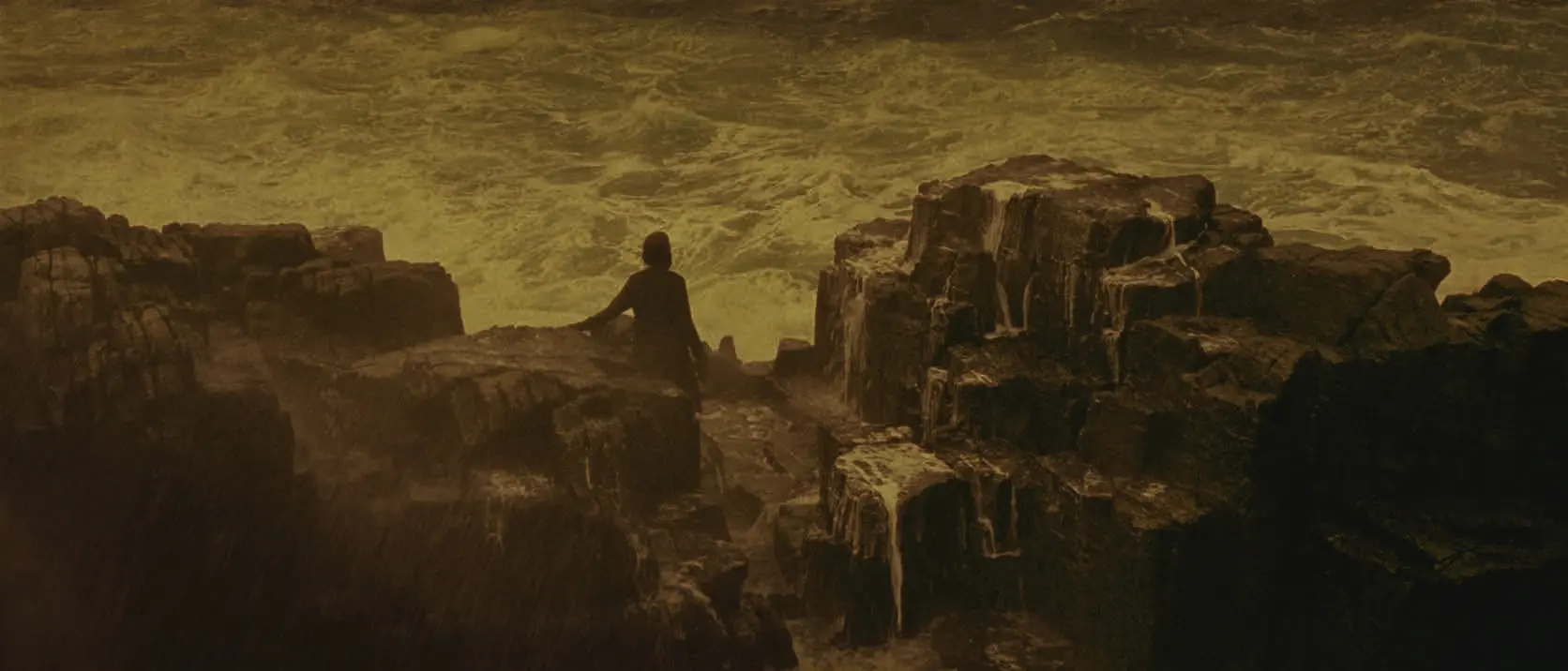
We see Bess overwhelmed by feelings and waves, overlooking the horizon, as the Wanderer above the sea of fog from 1818 by the German painter Caspar David Friedrich. One of the most iconic paintings of the 19th century depicting an artist wandering in a dangerously wild and pristine landscape. Elevated on a rock high above the brutal peaks partly covered by clouds, his hike is a journey of contemplation. Through demanding efforts and suffering, he has finally reached a position offering him the grand overview, but the fog is still there, symbolizing an uncertain future.
Where Friedrich’s wanderer seems more determined to proceed his journey, there seems to be a hopelessness state-of-mind in the Impossibility of breaking a wave, reflecting Bess’ monologue with God directing her into the arms of disaster.
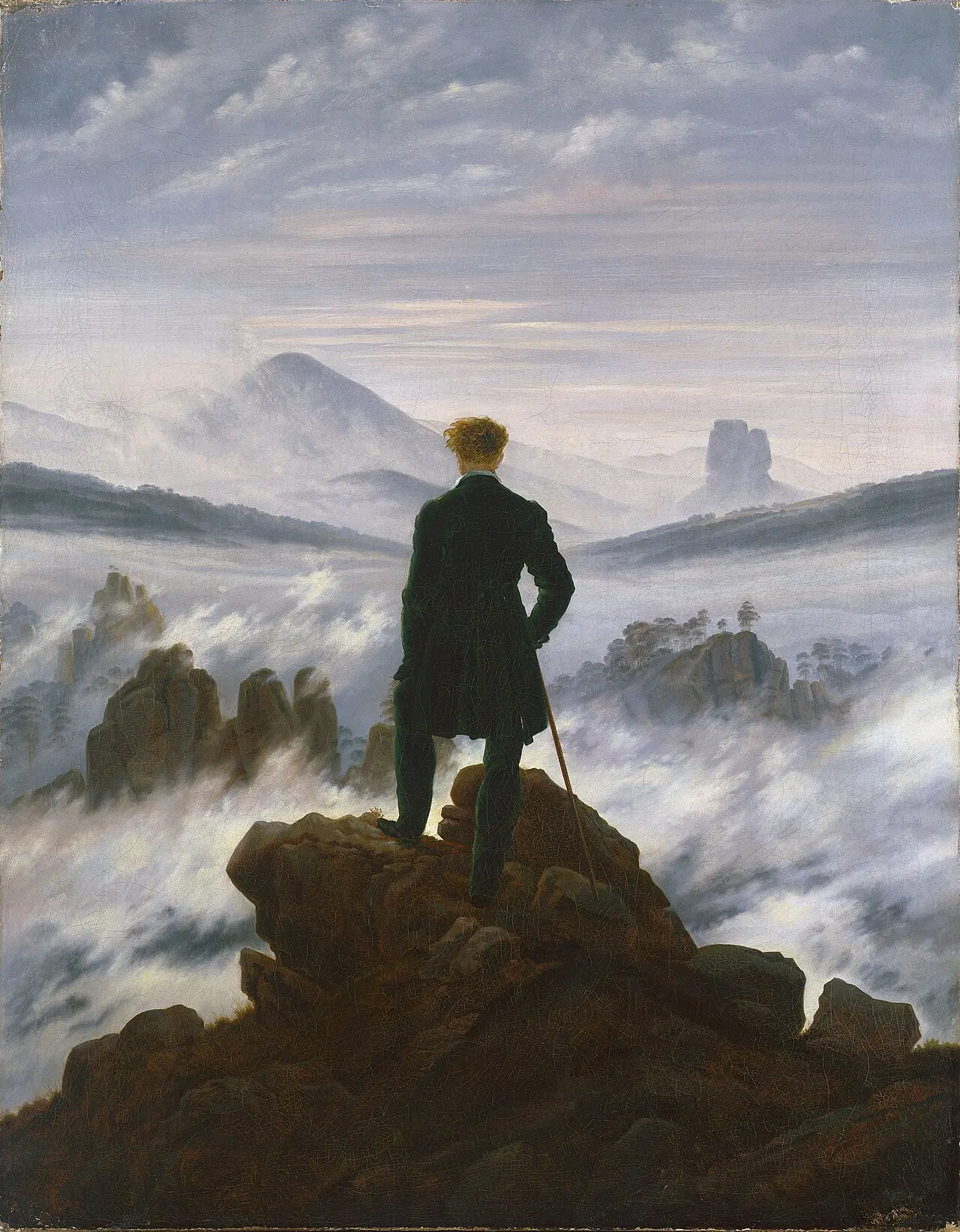
Caspar David Friedrich · c. 1818
Both captivated and frightened
In 1808, Friedrich made another masterpiece, The Monk by the Sea, which is a much more metaphysical piece closer related to abstract expressionist painting than to traditional Romantic art. We see an immense sky, with stormy clouds pressing against a black ocean carved by white foam. A storm is approaching, yet a tiny figure is standing on the shore observing the unstoppable chaos, which is about to unfold. He is a monk, a man of God, immersed in his church, the nature. The sublime resembles, according to the Irish, 18th-century philosopher Edmund Burke, the ambiguous feeling of being both captivated and frightened in the presence of overwhelming natural phenomena as a volcanic eruption or a storm at sea. It threatens to overthrow the subject by reducing it to a mere object, which, as any other thing, can be destroyed by its vast and agonizing forces.
An unstoppable force
In our time, the climate philosopher Timothy Morton has coined the term hyperobjects. A hyperobject is transcending localization, in the sense that one may be able to think the object but not necessarily see it or touch it. Nevertheless, it is real, it exists. It distributes massively across time and space, as a web of interconnected actions and consequences, such as global warming. It’s a non-human agent (but perhaps human-caused), an unstoppable force, which is so hard to grasp that we often tend to ignore it. One may say that Friedrich was depicting hyperobjects in a time, where man was thought to still be subjected to nature, to God, long before we became aware of our own destructive force in the current age called the Anthropocene.
Friedrich also depicted nature as the place where answers would unfold. Where ideas, such as the idea of God, would materialize autonomously in the mind of man. In The impossibility of breaking a wave, Bess is walking to the rocky shores for answers from her God, just as the wanderer overlooking a sea of clouds, and as the monk by the sea. Though positioned safely on the rocks, white foam and streams of receding water adds a notion of uncertainty. She is not at all safe, and just as the wanderer facing the possibility of his own end, she might do so as well.

FROM FRAME TO ARTWORK
The film moves on.
The image remains.
The frame explored in this essay exists as a limited ARTvonTRIER edition.
VIEW THE EDITION →Essay by Malou Lykke Solfjeld · Co-author Christian Kortegaard Madsen
Reference works: Caspar David Friedrich · Hamburger Kunsthalle · Alte Nationalgalerie, Berlin